
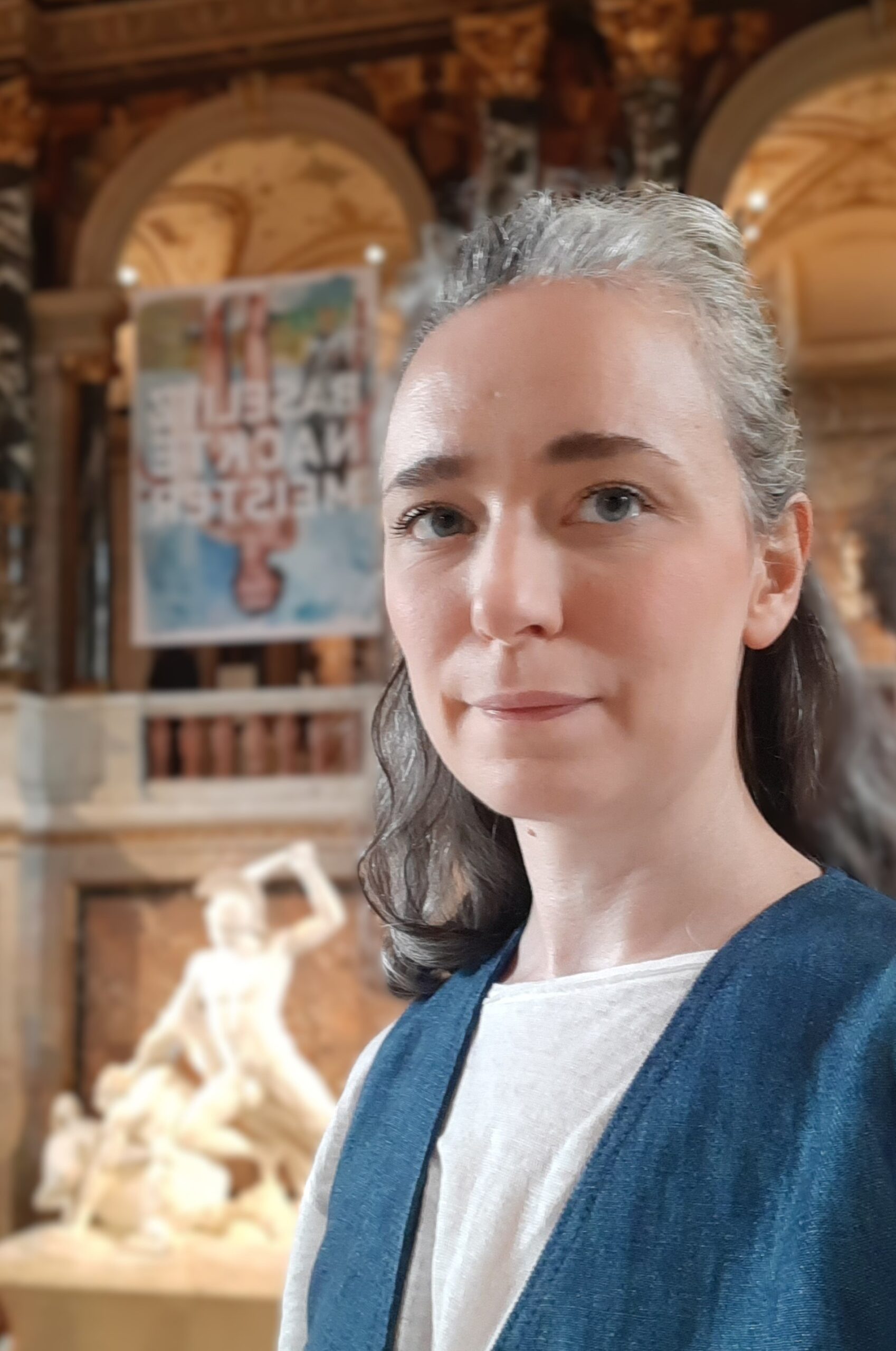
Dr. Justyna Balisz-Schmelz studied art history at the Jagiellonian University in Kraków, Humboldt Universität and Freie Universität in Berlin. Since 2017 she has been an assistant professor at the Department of Modern Art History in the Institute of Art History at the University of Warsaw, where she teaches the history and methodology of contemporary art. Her research to date has focused on German art after 1945 in the context of cultural memory studies and Polish-German artistic relations. She is the author of the book The Unsourmountable Past: The German Post-1945 Art as the Space and Medium of Memory (Kraków, Universitas, 2018) and numerous journal articles in which she continuously updates and expands upon the reflections contained in it (“Stranger in One’s Own Country”: Afro-Germans and Post-Unification Memory Contests in Laura Horelli’s Namibia Today and the Works of Ingrid Mwangi Hutter”, “Widok. Teorie i Praktyki Kultury Wizualnej”, No. 29/2021; “Who Are the Turks, Jews, and Other Germans? Reflections on Peter Chametzky’s Latest Book,” “Przegląd Zachodni”, 3 (387)/2023).
Since writing an essay on the Silesian artist Urszula Broll for the catalogue of her retrospective exhibition at the National Museum in Warsaw – Królikarnia in 2021, her second field of research has been the relationship between contemporary art and alternative forms of spirituality in Central and Eastern Europe (mainly Poland and the GDR) as well as in postwar Germany. Since 2025 she has been a member of the Central and Eastern European Network for the Academic Study of Western Esotericism (CEENASWE). She is co-organizer of the international conference Enchanted Socialist Modernity? Art of Central and Eastern Europe in the Face of Esotericism and Unconventional Spiritualities (2023), co-editor of the volume Enchanted Socialist Modernity. Art of Central and Eastern Europe (1945–1989) in the Face of Alternative Spirituality, eds. Justyna Balisz-Schmelz, Kamila Dworniczak (Brill, 2025), as well as co-author and principal co-investigator of the NCN Opus grant project Alternative Forms of Spirituality in Polish Art 1945–1989 (2024–2028), https://alternative-spirituality-in-art.ihs.uw.edu.pl/en/ As part of the project, she investigates, among other things, the relationship between alternative spiritualities and art from the perspective of cultural borderlands, the impact of Carl Jung’s psychology and “Eastern spirituality” on the concepts and functions of the image in postwar Poland, as well as on the understanding of the relationship between vision and cognition in modernism. She is currently also working on a spiritual-artistic monograph of Urszula Broll.
Monographs:
- Przeszłość niepokonana. Sztuka niemiecka po 1945 roku jako przestrzeń i medium pamięci [The Unsourmountable Past: The German Post-1945 Art as the Space and Medium of Memory], Universitas, Kraków, 2018.
Edited volumes:
- Enchanted Socialist Modernity. Art of Central and Eastern Europe (1945-1989) in the Face of Alternative Spirituality, red. Justyna Balisz-Schmelz, Kamila Dworniczak, Brill 2025.
Chapters in edited volumes:
- “The Secret Emissary of Saxony: the Mystical “Communist Realism” of Carlfriedrich Claus in Light of Jacob Böhme’s Concepts”, w: Enchanted Socialist Modernity. Art of Central and Eastern Europe (1945-1989) in the Face of Alternative Spirituality, red. Justyna Balisz-Schmelz, Kamila Dworniczak, Brill 2025, ss. 151-174.
- “Spiritual Self-Education as a Micropolitics of Resistance: Urszula Broll’s Mandalas”, w: Enchanted Socialist Modernity. Art of Central and Eastern Europe (1945-1989) in the Face of Alternative Spirituality, red. Justyna Balisz-Schmelz, Kamila Dworniczak, Brill 2025, ss. 275-301.
- From a Dead-End Street in the West to the East. Alice Lex and Oskar Nerlinger, w: Cold Revolution. Central and Eastern European Societies, red. Joanna Kordjak, Jerome Bazin, Mousse Publishing 2021, s. 66-73.
- Dosłowność jest więzieniem. O „Uśpionych trajektoriach” Alicji Bielawskiej, w: Uśpione trajektorie, red. Marta Lisok, BWA Katowice 2021.
- W cieniu socjalistycznej utopii, w: Miasto / Fotografia / Archiwum, red. Barbara Kubska, ASP Katowice 2021.
- Co pozostaje? Anty-pomniki Gerzów a medialne ramy pamięci. Rewizja po latach [What remains? Anti-monuments of the Gerzes and media frameworks of memory. Years later: a diagnosis], w: Rzeźba dzisiaj 4. Antypomnik i nietradycyjne formy upamiętniania, red. E. Domanowska, M. Smolińska, Orońsko 2020, s. 9-20.
- Pictures for the Fathers: Baselitz’s „Heldenbider” as Anti-Images of the Socialist and Fascist Body, w: Image, History and Memory, Routledge 2022.
- Foreign Relatives: How German is Polish post-war Expressionism?, w: Polish Avant-garde in Berlin, red. M. Stolarska-Fronia, Peter Lang Verlag, Berlin 2019, s. 243-262.
- Pieśni o wygnaniu i pragnieniu: archiwa afektywne Karoliny Grzywnowicz [Songs of Exile and Longing: the affective archives of Karolina Grzywnowicz], w: Głębokie słuchanie, red. M. Lisok, Katowice 2019.
- Odwrotność rzeczywistości. O alternatywnym modernizmie Urszuli Broll [The Reverse of Reality: On Alternetive Modernism by Urszula Broll], w: Urszula Broll. Atman znaczy oddech, red. K. Kucharska, Fundacja Katarzyny Kozyry, Warszawa 2020.
- Większość zostaje zapomniana, czyli o tym, dlaczego warto wysłuchać wspomnień i zajrzeć na strych, w: Życie obrazów, Fundacja Stefana Gierowskiego, Warszawa 2020.
- Rozpalić i zdmuchnąć. Rzecz o pożytkach i szkodliwości pisma dla pamięci, w: O powstawaniu i ginięciu, red. M. Lisok, Katowice 2016.
- Kiedy pamięć staje się ciałem. Anselm Kiefer, Georg Baselitz – wczesne prace, w: Strategie wystawiania, red. M. Hussakowska, Ewa M. Tatar, Universitas, Kraków 2012.https://universitas.com.pl/produkt/3027/Display-Strategie-wystawiania
- Ciało, w: Modi Memorandi. Leksykon kultury pamięci, red. M. Saryusz-Wolska, R. Traba, Warszawa 2014.
Journal articles:
- „Kim są Turcy, Żydzi i inni Niemcy? Refleksje wokół najnowszej książki Petera Chametzky’ego”, „Przegląd Zachodni”, 3 (387)/2023, ss. 149-161.
- “Stranger in One’s Own Country”: Afro-Germans and Post-Unification Memory Contests in Laura Horelli’s „Namibia Today” and the Works of Ingrid Mwangi Hutter, „Widok. Teorie i Praktyki Kultury Wizualnej”, No 29/2021.
- Terrified by the Close Other. Is the Postwar History of German Art Ready to Embrace “State Functionaries”?, “RIHA Journal”, 31.08.2020.
- Ścieżka dźwiękowa wygnania. Archiwa afektywne Karoliny Grzywnowicz, „Konteksty”, 1-2/2020, s. 378-386
- Duchowe samokształcenie jako strategia oporu. ”Mandale” Urszuli Broll, “Widok. Teorie i Praktyki Kultury Wizualnej“, 26/2020.
- Which Polish? What Neue? What Wilde? Provincialisation of the centre – centralisation of the province on the example of the Duesseldorf Papers by Marek Sobczyk and Jarosław Modzelewski, “Quart. Kwartalnik Instytutu Historii Sztuki Uniwersytetu Wrocławskiego”, 2020, w druku.
- „Ewokują monstra rozkładu”. Ogólnopolska Wystawa Młodej Plastyki „Przeciw wojnie – przeciw faszyzmowi” w świetle „niemiecko-niemieckiego” sporu o ekspresjonizm, „Folia Historiae Artium”, Seria Nowa, t. 16/2018, s. 119-132.
- Piszę, lecz nie opisuję. Pamięciotwórcza funkcja pisma w pracach Hanne Darboven, „Zeszyty Artystyczne”, 2(31)/2017, s. 83-96.
- Verkörperte Geschichte. Erinnerung an die Tragödie des Zweiten Weltkrieges in ausgewählten Kunstwerken von Mirosław Bałka, Magdalena Abakanowicz und Artur Żmijewski, „Historie. Jahrbuch des Zentrums für Historische Forschung Berlin der Polnischen Akademie der Wissenschaften“, 1/2007-2008, s. 35-40.
Conference papers:
- Occulture and Eigen-Sinn in the “Communist Realism” of Carlfriedrich Claus. A Tide of Ghosts: Esotericism and Art beyond Fact and Fiction, Kopenhaga, Department of Arts and Cultural Studies and SNASWE -Scandinavian Network for the Academic Study of Western Esotericism, 23.10–25.10.2024.
- Enchanted Socialist Modernity. (Re)Imagining Spiritual (in) Art History of Central and Eastern Europe. 2025 Spirituality and the Arts, Harvard University, 23.04–25.04.2025.
- The Light Within Us Is One”. Eco-Spiritual artistic Modernism of Jerzy Ćwiertnia (1928–2009). Socialist Eco-Aesthetics: Networks of Art and Ecology in the ‘Eastern Bloc’” , TechnischeUniversität Dresden, 4.06–6.06.2025.
- ‘One Must See With All Eyes’ Art, Science and Esotericism in the Early Decades of the Polish People’s Republic”(together with dr Kamila Dworniczak). 10thBiennial Conference of the ESSWE – European Society for the Study of WesternEsotericism, Vilnius, 26.06–28.06.2025.
- Polnische Neue Wilde? Die deutschen Bilder von Marek Sobczyk und Jarosław
Modzelewski als Ansatz zur Reflexion über die Herausbildung des westlichen Kunstkanons in den Achtzigerjahre. Un/Sichtbarkeit. Die polnische Kunst(geschichte) und Deutschland. Tagung am Zentralinstitut für Kunstgeschichte München”, 06.04–08.04.2022 r.
- The Soundtrack of Exile. Affective Archives by Karolina Grzywnowicz. Memories in Transit. Transnational Memory and Identity Across Modern Regimes of Displacement and Dispersion, University of Cambridge, The Centre for the Study of Global Human Movement, 15-15.04.2021.